Montgomery MadeA Soul Noir Story
A city that never fully sleeps.
Downtown
Where the money changes hands and the cameras look the other way.
The Gump
Montgomery by its street name. Home — if home could hold a grudge.
The Nightclub
After hours, every deal in the city gets a soundtrack.
The Studio
Four walls, a mic, and the only place Soul feels safe. For now.
Nine souls. One city. No clean hands.
Everyone in Montgomery Made wants something. Pull a dossier.
Every case starts on the board.
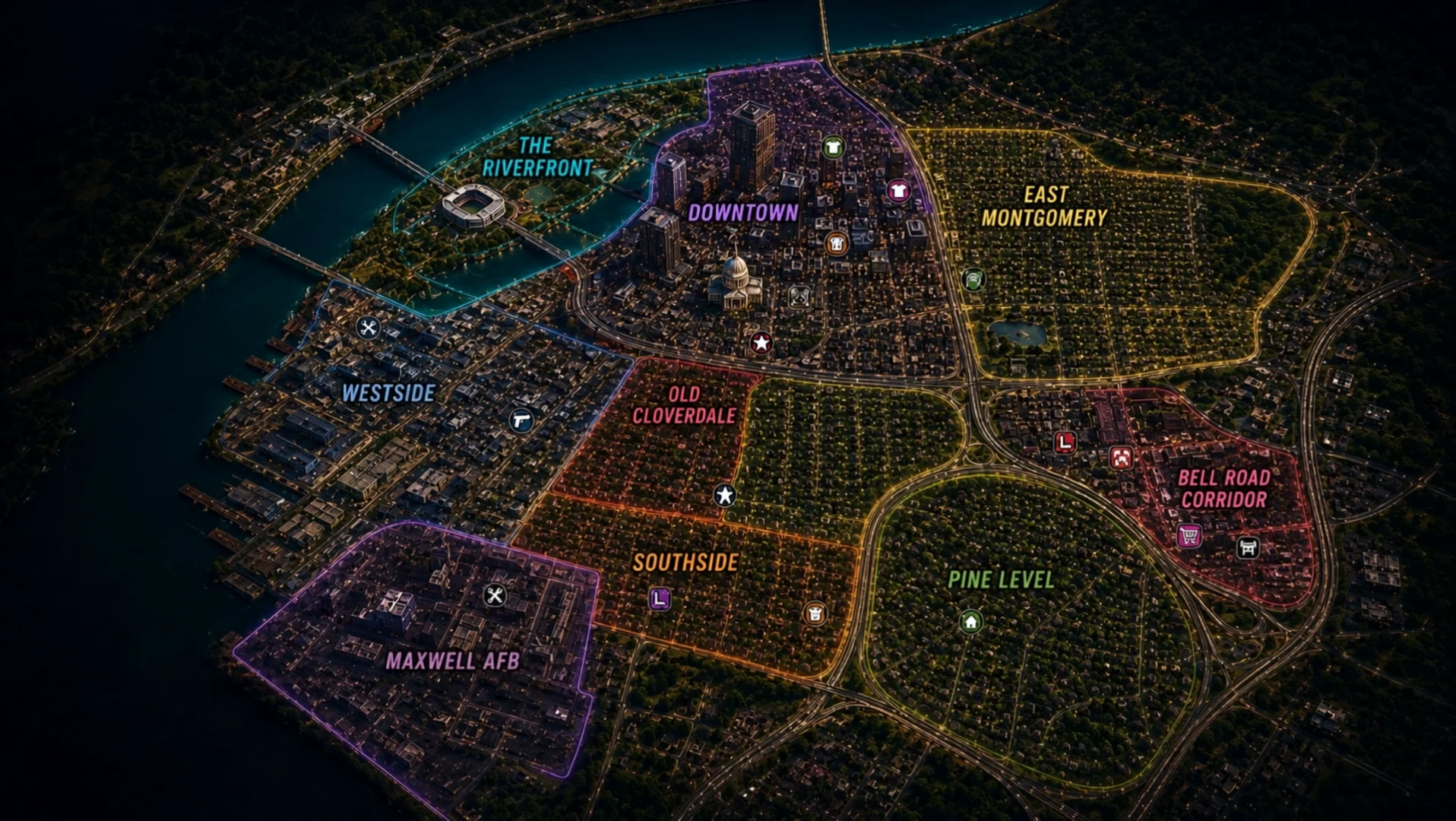 DowntownThe GumpThe NightclubThe Studio
The city is a character too.
Some of these places appear in the series. All of them are real. Pull the history and explore the Montgomery that made the story.
Dexter Avenue King Memorial Baptist Church
Dr. Martin Luther King Jr. served as pastor here from 1954 to 1960. Its basement was a nerve center for the Montgomery Bus Boycott, and today the church is a National Historic Landmark.
Explore at dexterkingmemorial.org ↗Rosa Parks Museum
Built on the corner where Rosa Parks was arrested for refusing to give up her seat — the spark of the 381-day bus boycott. Operated by Troy University on the site of the old Empire Theater.
Explore at troy.edu ↗Civil Rights Memorial
Designed by Maya Lin for the Southern Poverty Law Center, the black granite fountain names 41 people killed in the struggle for equal rights between 1954 and 1968.
Explore at splcenter.org ↗Freedom Rides Museum
The former Greyhound bus station where Freedom Riders were attacked by a mob in 1961. Now a museum preserving the story of the young people who rode into Montgomery to challenge segregation.
Explore at Alabama Historical Commission ↗The Legacy Museum
The Equal Justice Initiative's museum traces the line from slavery through Jim Crow to mass incarceration, paired with the nearby National Memorial for Peace and Justice.
Explore at legacysites.eji.org ↗Alabama State Capitol
The marble steps where the 1965 Selma-to-Montgomery march ended and Dr. King delivered 'How Long, Not Long.' A working capitol and National Historic Landmark carrying the weight of its full history.
Explore at Alabama Historical Commission ↗Alabama State University
Started by the 'Marion Nine' — nine formerly enslaved men who built a school for people who'd been denied the right to read. Their Lincoln Normal School became one of the nation's first state-supported universities for African Americans and moved to Montgomery in 1887; its students and faculty later helped power the Bus Boycott.
Explore at alasu.edu ↗The City of St. Jude
A Catholic mission founded by Father Harold Purcell — a church, school, and hospital serving Montgomery's African American community. On the last night of the 1965 Selma-to-Montgomery march, thousands camped on its grounds for the 'Stars for Freedom' rally before the final walk to the Capitol.
Explore at National Park Service ↗George Washington Carver High School
Montgomery's high school for African American students under segregation, named for the pioneering scientist George Washington Carver. Generations of the city's leaders, artists, and athletes came up through its halls.
Explore at Wikipedia ↗Photos via Wikimedia Commons. Alabama State Capitol (HABS), the Rosa Parks arrest photograph (1956), and the City of St. Jude (Carol M. Highsmith) are public domain. Dexter Avenue Baptist Church (Punktoad), Freedom Rides Museum and Alabama State University (Michael Barera), and Carver High School (Spyder Monkey) are licensed CC BY-SA.
The story so far.
Be first through the door.
New chapters, character drops, and premiere dates for Montgomery Made — straight to your inbox.